
Volume 40 Number 3 | June 2026
Summary
This article emphasizes the value of experienced laboratorians as “living memory” within complex healthcare systems. By honoring their insights and integrating past lessons into innovation—through tools like pre-mortems and structured reflection—medical laboratories can strengthen change efforts, preserve stability, and turn repeated cycles into sustainable, meaningful progress.
Creating Space for Innovation While Honoring Lived Experience
Julie Freidhoff, MS, MLS(ASCP), Volunteer Contributor
 Those who remember the past are the guardians of the future.
In nearly every laboratory, there are individuals who quietly embody this truth.
They may not speak first in meetings or hold the newest title. Yet if you ask about a process, a workflow, or a past initiative, they will pause, smile slightly, and begin to tell the story.
They remember when a procedure was first introduced, when it changed, and sometimes—years later—when it quietly returned in a form strikingly familiar. They have witnessed instruments evolve, regulations expand, and improvement initiatives come and go.
They have adapted, again and again, ensuring patient care remains steady and reliable—learning along the way that progress rarely moves in a straight line.
Consider a familiar pattern: inventory is centralized to improve oversight. Years later, bench stock returns to reduce interruptions. Processes become tightly standardized across a department. Later, flexibility is reintroduced to support real workflow needs.
This is not failure. It is the natural rhythm of complex systems learning about themselves.
The Rhythm of Leadership and Learning
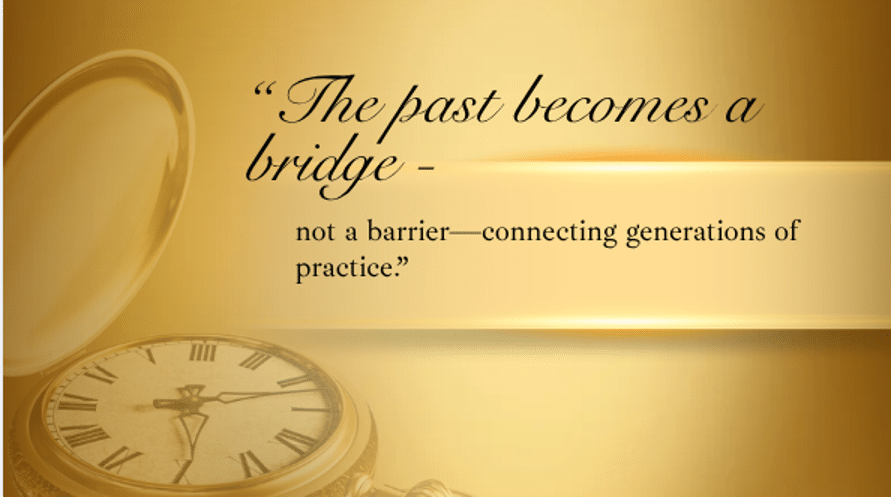
Image created by Julie Freidhoff using Canva
Leadership transitions are part of this rhythm.
Each new leader brings energy, perspective, and a sincere desire to improve the system. Often, the ideas they champion have been tried before—but now align differently with timing, resources, or priorities.
Yet leadership turnover is common, and the responsibility is immense. Work units may experience cycles of new initiatives, each introduced with momentum and hope.
At the bench, something else is often noticed quietly: We’ve seen this before.
This is not a criticism of leadership. It is the nature of complex systems.
When people move on, something else may leave with them—not just information, but continuity. The steady understanding of what has been tried, what was learned, and what allowed the system to hold.
Systems Remember through People
Healthcare organizations carefully document procedures. Policies are written, validations performed, and metrics tracked.
Yet many of the most valuable lessons are not fully captured in documentation. They live in experience.
Over time, laboratorians develop deep pattern recognition. They notice where interruptions build, where cognitive load increases, and where small adjustments quietly protect accuracy and flow. They sense when something feels off—often before a metric confirms it.
In other words, systems remember through people.
When experienced laboratorians are not invited into improvement conversations, these insights can fade from view. Organizations may unintentionally repeat earlier efforts—or remove safeguards that once served a purpose.
What appears as simplification can erode stability, leaving leaders asking: What changed?
Often, the answer lies in what the system once learned—and then forgot.
Equally important, those who have carried the work for decades often speak from experience that can be misinterpreted as resistance. In reality, they are offering insight—hard-earned, pattern-based, and deeply informed.
The Natural Historians of the Laboratory
Within every laboratory there are individuals who carry its living history. They remember why processes evolved, where challenges emerged, and what allowed the system to succeed over time. They are the natural historians of the laboratory.
When their voices are invited into improvement efforts, innovation becomes stronger—not because it resists change, but because it helps change endure.
And when that history is made visible—not just assumed—it serves a dual purpose. For the experienced laboratorian, it is honoring. It recognizes that years of observation and contribution matter. For the new employee, it becomes orientation. It provides context for why processes exist, what has been tried before, and how the system has learned over time.
In this way, the past becomes a bridge, not a barrier—connecting generations of practice.
From Memory to Momentum
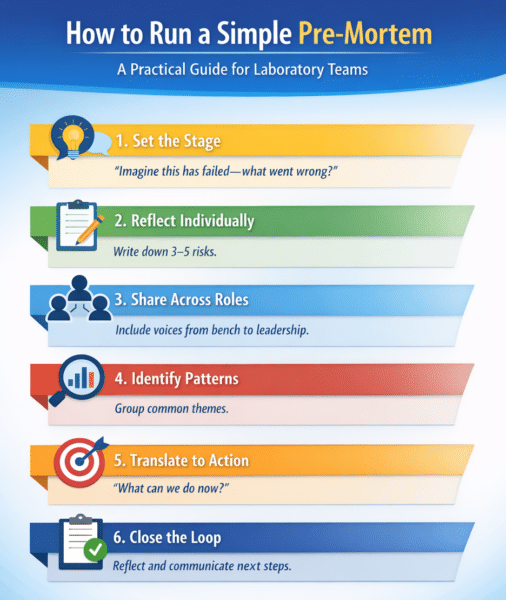
Image created by Julie Freidhoff using ChatGPT
As laboratories innovate, the question is no longer whether change will occur—but how well it will hold. One practical way to bridge past insight with future action is through a pre-mortem, developed by Gary Klein.
A pre-mortem asks teams to imagine that a project has failed—and then to explore why. At its best, this is not about predicting failure. It is about creating the conditions for truth. It invites those closest to the work to share what they already see:
- Where workflows may strain
- Where past challenges may re-emerge
- Where small, often invisible factors may influence success
In doing so, risk shifts from something reviewed later to something revealed early. And often, what surfaces is not new information—but remembered insight, finally given space to be heard.
Creating Space for the Laboratory’s Memory
In many environments, the challenge is not identifying risk, it is creating the space where people feel safe enough to speak it out loud.
When risk feels like a critique, it is softened. When experience is labeled as resistance, it is quieted. But when reflection is invited, something changes.
Leaders can create that shift by asking:
- Have we explored this before?
- What did the system learn last time?
Departments can also make their history visible—through shared stories, timelines, or simple acknowledgments. These efforts do more than preserve memory. They orient those who are new. They honor those who have stayed. And they remind everyone that today’s work is part of something larger.
A Practical Tool for Reflection
When exploring the history of change, a structured framework can guide conversation. The Lippitt-Knoster Model for Managing Complex Change helps teams understand why initiatives succeed—or struggle.
Rather than asking “Did this work?” the model invites reflection on:
- Vision: Did the team understand the purpose?
- Consensus: Was there shared agreement?
- Skills: Were people prepared to succeed?
- Incentives: Did the change feel meaningful?
- Resources: Were time and tools sufficient?
- Action Plan: Was there a clear path forward?
Using this lens, experienced laboratorians can share what supported success, what barriers emerged, and what helped improvements last. It becomes more than a change model, it becomes a way to listen, honor history, and mentor the next generation.
Moving Forward Together
The future of laboratory medicine will bring new technologies and new approaches to care. Innovation is essential; but it is rarely entirely new. More often, it is a “new to us” idea—a refinement or evolution of what has come before.
In this way, the laboratory’s most valuable resource is already present: the people who remember; the people who adapt; and the people who quietly protect what works. The laboratory remembers through them.
And when we pause to listen, we gain something invaluable—the wisdom that transforms repeated effort into meaningful, sustainable progress.
Reflective Close
Pause.
Listen.
Honor.
In doing so, we allow the wisdom of the past to guide the innovation of the future.
Julie Freidhoff is a Coach and Consultant at SafeSpace Coaching and Consulting in Rochester, Minnesota.