
Volume 39 Number 4 | August 2025
Summary
Advocacy in medical laboratory science begins on a personal level, through individual conversations and education. Author Katie Guise emphasizes that sharing personal stories and educating others—whether peers, legislators, or students—builds awareness and humanizes the profession. While large-scale initiatives matter, everyday interactions form the foundation of lasting advocacy and meaningful change in medical laboratory science visibility.
Katie Guise, MLS(ASCP)CM, 2024-25 ASCLS Developing Professionals Forum Chair
 In the world of professional advocacy, especially within the walls of a well-established organization like ASCLS, I find that it is easy to wonder: Am I doing enough?
With wide reaching social media campaigns, large scale initiatives, and organized national events like the Labvocate Symposium, it is easy to see the passion for advocacy held by our membership. Having attended the Labvocate Symposium twice, and planning to head back to D.C. come October, I would be the first to say that these events are nothing short of inspiring. However, advocating for our profession goes far deeper than events taking place on this scale—and it’s important to not equate impact with size. The most meaningful advocacy can take place on a much smaller level—one conversation, one connection at a time.
For me, advocating for my profession begins with education. Most people understand when they go to the doctor and tests are ordered, results will come back and guide treatment. This oversimplification creates a disconnect—an impression that this process is passive, like a machine quietly turning in the background. It’s clear what’s missing from this picture: the human element—our diverse community of laboratory professionals making those results possible.
During my undergraduate education, I quickly saw just how wide this gap in knowledge was. In just explaining what I was studying to my friends and peers, I knew there was an opportunity to start a lasting impression. I had to first educate myself as a budding MLS student: Who are the professionals in the clinical lab? What exactly is the scope of my practice? Then I focused on answering these questions clearly, particularly for people with no healthcare background. That ability to explain, to connect, became my “in.” This changed the way I looked at advocacy, something I had largely connected with sweeping legislation or media connection, and redirected it in a powerful way.
Advocacy, I discovered, is deeply personal. Empowering ourselves as laboratorians by understanding the value of our work is more than just a steppingstone into the vastness of professional advocacy, it is the very foundation. It can be as simple as sharing your story or perspective with a friend, creating a connection to humanize our profession. The power of one person—to inform, to connect, to humanize—is how true change begins.
During this past year’s Labvocate Symposium, I experienced the power of this micro-level advocacy firsthand. After speaking with several legislative offices, we met a staffer for a Florida representative who stood out for his genuine interest in our cause. As it turned out, his partner was a laboratory scientist, and he had firsthand seen the strain our profession endures. That personal connection transformed our meeting from a policy pitch into a conversation with real emotional weight. That moment reinforced a simple truth: relationships and personal stories often carry more influence than facts alone.
This approach isn’t just limited to connecting with our peers or legislators—it’s something that can be carried into everyday conversations with just as much impact. Here in Florida, I volunteer for a handful of K-12 STEM education events, one of which being a STEM fair at my alma mater, the University of Central Florida. Here, I speak to a much younger audience—an audience with much more limited understanding of the healthcare system. Rather than see this as a barrier, I am excited to be the first person to introduce them to the laboratory sciences.
I first learned about our field during college, but with my efforts, I’m able to bring visibility to our profession for some students at a much younger age. While I know many of these kids won’t become laboratory professionals, the purpose of the exercise is much simpler: they know the basics of what we do and put our profession on the map in the same way they grow up learning about doctors, nurses, and other parts of the care team. While it may be easy to overlook this type of activity in favor of more wide-reaching efforts, our collective goals for improving the profession rely on visibility, and every step, every connection, counts.
Each time we share what we do, educate others, or speak up about the realities of our field, we strengthen our collective voice. Micro-level advocacy is not a lesser form of engagement—it’s the backbone of our movement. It’s how we build awareness, empathy, and, ultimately, change.
Katie Guise is a Medical Laboratory Scientist (Generalist) for Orlando Health in Orlando, Florida.
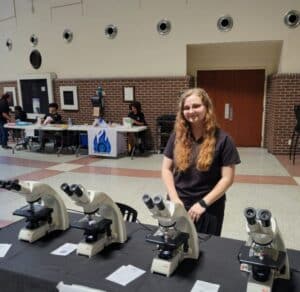

Author Katie Guise volunteers at a K-12 STEM education event to introduce young students to the laboratory sciences and put the profession on the map with other careers, like doctor and nurse.
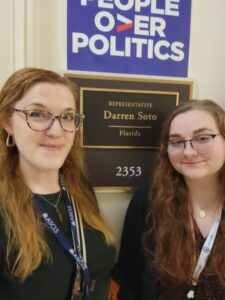
Emily Woten and Katie Guise visit their Congressional representative during the 2024 Labvocate Symposium.
“That moment reinforced a simple truth: relationships and personal stories often carry more influence than facts alone.”