
Volume 40 Number 5 | October 2026
Summary
In this thought-provoking article, Julie Freidhoff explores how technology systems can become an “invisible third party” in workplace interactions, creating misunderstandings and misplaced blame. She encourages medical laboratory professionals to recognize system-related failures, approach colleagues with curiosity rather than assumptions, and promote accountability, psychological safety, and stronger workplace relationships through better communication and system oversight.
Julie Freidhoff, MS, MLS(ASCP), Volunteer Contributor
 Two stories you may recognize: Not long ago, my child’s middle school emailed me a PDF form to be completed. I followed it faithfully: it highlighted a field; I filled it in. It jumped to the next prompt; I responded. It prompted me to submit; I did. I trusted the process, as we are all trained to.
Days later, an email from the school representative declared I had made a mistake: I missed a required field—one a previous email had explicitly outlined as required. There was an error; that much was true. The field came through incomplete. But blame for the error was assigned, erroneously, to me: the only other person in the workflow. The truth: I did exactly what the form prompted—and the form never took me to that field. The flaw was in the application’s design. He didn’t design it. I didn’t. Yet the only two humans in this workflow ended up at odds over a mistake belonging to neither of us—and neither could ask the app a question or hold it accountable.
The second story happened at work, in a previous role. As a new employee in a quality role, I found myself in need of an older version of Adobe (to review QC data from the GEM blood gas analyzers). I carefully navigated the organizational self-service access-request system and submitted. Denied. My trainer repeated the process with me. Denied again.
Weeks later, a personal email arrived from IT (with my supervisor cc’d), tinged with anger: Stop requesting access. It is inappropriate for you to keep submitting this request. You are not going to get it. I had no idea what he meant. The system was glitching, automatically resubmitting the request each time it was denied. Stuck in a loop. He didn’t see a broken system. He saw my name, over and over, and his brain wrote a story: this new employee is pushy, inappropriate, difficult.
Picture being new to an organization, still working to belong, and reprimanded by a stranger for something you didn’t do. What happens in your body as you imagine it?
Naming the Phenomenon
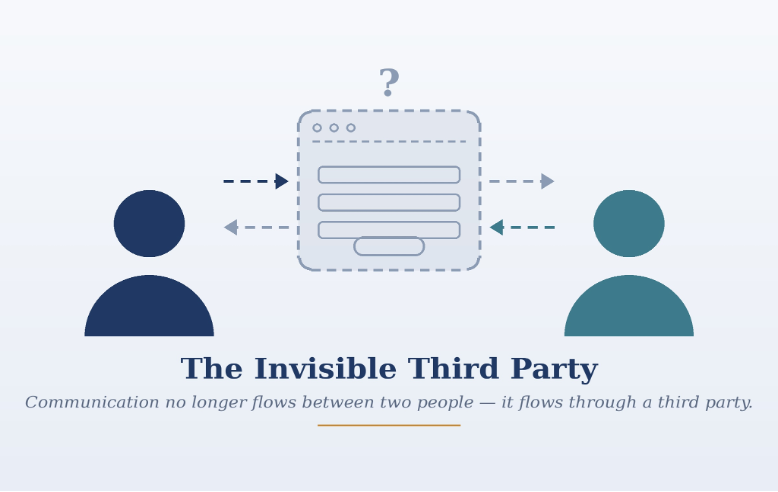
A third party has entered our workplace relationships, and we don’t even know to acknowledge it. Communication no longer flows between two people; it flows through a third party: the form app, the self-service portal, the ticketing system. It has no tone of voice, no ability to clarify or apologize—and when it errs, the error doesn’t wear the system’s name. It wears ours. The two humans turn on each other while the third party slips out of the room, leaving two dysregulated people behind.
I call this the invisible third party. Once named, you see it everywhere—and you can stop absorbing blame that was never yours and stop assigning blame that was never your colleague’s.
Why Our Brains Blame People, Not Systems
Hold three anchors: felt safety, connection, and regulation—what our nervous systems need, and what these encounters take.
- Threat mode. When an accusatory email arrives, the body responds before the thinking brain does. The amygdala sounds the alarm; the prefrontal cortex, home of perspective-taking and curiosity, goes partially offline. In threat mode, no one wonders, could there be a system variable here? We feel, I am not safe with this person. The sender was in threat mode too.
- The brain is a story-making machine. Our minds abhor ambiguity. Given a gap, the brain fills it with a confident narrative. The IT professional’s brain wrote a story about me; the school representative did too. Neither was true, but both were presented as fact—and a digital third party is a fountain of ambiguity.
- The fundamental attribution error. We tend to attribute others’ behavior to their character rather than their circumstances. A form arrives incomplete; we conclude the sender is careless, not that the software failed. Our brains evolved to assess people; our ancient social wiring has no category for software. So, blame defaults to the nearest human face.
- The cascade. The experience drives dysregulation—my body flooded reading that email. Dysregulation drives disconnection—I felt unsafe with a colleague I’d never met, and he with me. Accusatory language destroyed felt safety—“inappropriate” told my nervous system this was not a safe place to be new. And the residue was broken trust: for a long while after, I approached that system braced, expecting it to misrepresent me again. Multiply one invisible glitch across a workplace, and you see why this belongs in a conversation about mental health.
None of this is a character flaw; it is predictable neurobiology. But predictable is not inevitable. Knowing this offers us compassion, not a pass. We get to acknowledge what’s happening in our brains and take responsibility for our response. In fact, that’s exactly where our growth lives: in the space between the impulse and the choice.
Language to Talk About It
Shared language creates felt safety all by itself. Here are phrases I now use:
- “Before we assume intent, can we rule out the system?” Asked warmly, it signals I am curious with you, not against you.
- “I think we have a third-party problem, not a two-person problem.” This moves two people to the same side of an investigation.
- “Who owns this system, and how do we report suspected malfunctions?” This begins the work of accountability and of repair. When my IT colleague and I finally shared an accurate story, our nervous systems could stand down. That is what naming does.
Holding “It” Accountable
We would never place an instrument into service without validation, run without QC, or tolerate an analyzer with no named owner. Yet the software mediating our communication has none of these safeguards—no sandbox, no monitoring, no owner receiving error reports. We cannot hold an app accountable like a person. But we can insist someone be accountable for it:
- Regulate first. Feel your feet, lengthen an exhale, bring your whole brain back online. Then ask: what story is my brain making up, and could there be a third party in this exchange?
- Reconnect before you resolve. Move the conversation into human channels—a call, a face-to-face moment—where tone and repair are possible. Lead with curiosity and grace.
- Report system errors as system errors. Document the malfunction like a QC failure: what you did, what the system did, what was expected, what occurred. Send it to the system’s owner. If no one can name an owner, that is a finding worth escalating.
- Advocate for validation before deployment. Was it tested from the end user’s perspective? Is there a sandbox? A feedback mechanism? The questions we ask of every new analyzer, asked on behalf of every relationship the system touches.
The Empowering Truth
Every time we absorb a system’s blame, we carry a threat response that was never ours. Every time we misdirect frustration at a colleague, we lose connection—the very thing our nervous systems need to stay well. But when we make the third party visible, the cascade reverses: naming restores felt safety, felt safety allows reconnection, and nervous systems settle. Helplessness becomes agency.
So here is my invitation. Think back to a moment when a workflow left you stung or blamed. Was there a third party in the room? And if you have ever paused mid-frustration and wondered, is it the system? Kudos to you. You are already doing the work this article hopes to spotlight. Keep going: name it out loud, offer a colleague the benefit of the doubt, and start the conversation in your own laboratory. These systems entered our workflows without asking. Together, gently, we can make them visible and take our relationships back.
Julie Freidhoff is a Coach and Consultant at SafeSpace Coaching and Consulting in Rochester, Minnesota.