
Volume 39 Number 6 | December 2025
Summary
This article highlights the impact of inclusion in clinical laboratories, especially for LGBTQ+ professionals and patients. The author shares experiences of witnessing bias and emphasizes how discrimination harms both teamwork and patient care. Feeling genuinely welcomed at the ASCLS, AGT & SAFMLS Joint Annual Meeting reinforced the importance of diversity, belonging, and supportive professional communities in strengthening the medical laboratory workforce.
Breanna Mckenna, MLT(ASCP), ASCLS Developing Professionals Forum Counselor
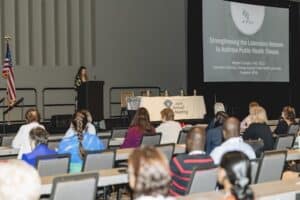
The ASCLS, AGT & SAFMLS Joint Annual Meeting was a new experience for author Beanna Mckenna that was inspiring and moving in terms of welcoming all medical laboratory professionals.
It was the last day of the trip. I hadn’t slept well all week. I was nervous about the upcoming day of travel I had ahead of me. But none of these worries could be blamed for my teary eyes in a conference room in Sacramento, California, on June 12.
Being a queer person in 2025 in healthcare is fraught with anxiety, and that is true for not only our patients, but for the professionals at work. I remember the first time I heard nurses on the floor demeaning and misgendering a transgender patient just a few feet from the door and, unbeknownst to them, just a few feet away from me, another genderqueer individual. Unfortunately, this behavior is not absent from the lab.
The transgender community ends up visiting the lab frequently, as hormone therapies must be carefully monitored. Even when bias is not visible to the patient during their visit, it can be felt behind the bench. Many times, I have witnessed disturbing conversations revolving around patient’s pronouns, the tests ordered, and implications about their lives.
As a clinical laboratory professional who is nonbinary, this is heartbreaking to hear. Imagine opening the wrong door and hearing the technologist on the other side calling you a slur, loudly proclaiming that “men don’t need a beta-hCG,” or that you can’t be called Jennifer and get your prostate specific antigen checked. When I hear these conversations, or see sneers on faces, it feels as though they are directed at me. Our patients can feel our prejudices, but so can our coworkers.
When we prioritize diversity, equity, inclusion, and belonging in our laboratories, we are benefiting our patients and our peers at the same time. The more diverse our workforce is, the more perspectives we hear, and the more ideas are brought to the table. As a phlebotomist, I never shied away from asking someone else to take a second look at a patient—even if they had less experience than me—because “your eyes might see something I can’t.” Our differences, our unique lived experiences, offer individual insights into our work, but if I’m working on the bench next to someone who is loudly and consistently discriminating against others in my community, am I going to have the courage to share my ideas?
“I was sitting in a room of primarily strangers, but I felt like I belonged.”
In January, I started the last semester of my MLT degree, and I was given an assignment to become a member of any professional laboratory society. We had been given assignments all month to learn about the many professional laboratory organizations out there. None piqued my interest so much as ASCLS, however. A society that values our profession, but even more so, the diverse people within it? Sign me up!
But the mission statement was not enough to prepare me for the welcome I would feel at the Joint Annual Meeting (JAM). To hear Past President Dr. Pat Tille, President-Elect Stacey Robinson, and current President Dr. Kyle Riding value inclusion so heavily in an administration and era where many underestimate its worth was so inspiring to me, it moved me to tears. I was sitting in a room of primarily strangers, but I felt like I belonged.
The past year has felt incredibly heavy for me, despite the excitement of graduating and becoming certified as a medical laboratory technician. I absolutely love the clinical laboratory, and everything we do within it. I have the biggest hopes and dreams for my career. Knowing that ASCLS will support me not only because of what I do, but because of who I am, will keep me renewing my membership and volunteering, however I can. I hope we can encourage others to do the same, for our patients and ourselves.
Breanna Mckenna is a Medical Laboratory Technician student at Western Dakota Technical College in Rapid City, South Dakota.