
Volume 40 Number 2 | April 2026
Summary
ASCLS has long centered patient safety as a core value, empowering medical laboratory professionals to protect patients through advocacy, education, and ethical practice. From early initiatives like the Consumer Information Response Team to today’s Diagnostic Equity partnership, the organization champions health literacy, diagnostic fairness, and a culture where laboratorians actively shape safer healthcare systems.
Kyle B. Riding, PhD, MLS(ASCP)CM, ASCLS President
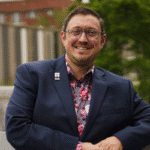 There are many truths about ASCLS that I have learned over my 22 years of membership and volunteerism. These truths center around the personal and professional strength I have gained from our pillars of excellence—community, advocacy, and knowledge. One important item intersects all three of these pillars and is part of the DNA of ASCLS. That is patient safety.
It’s easy to think of patient safety as something we talk about because it is a healthcare buzzword, or because new technologies have changed the way we approach error prevention. However, the truth is ASCLS has been at this work for decades—long before the term was used to give out awards or market healthcare enterprises. Our members have always recognized that laboratory professionals play a central role in protecting patients through the decisions we make and the standards we uphold every single day. We do this even though we rarely meet our patients. This is because compassion and caring are our strengths.
One of the examples of this commitment came in 1999 with the establishment of the Consumer Information Response Team by several mentors—most notably Dr. Susan Leclair. At a time when the internet was still young, and reliable health information was hard to come by, ASCLS volunteers took it upon themselves to answer questions from patients and providers seeking to understand laboratory results. It was an early act of assuring diagnostic equity, even if we didn’t use that term yet. ASCLS members were helping people interpret confusing medical information, empowering them to ask better questions, and advocating for clearer communication between laboratories and patients.
By the mid‑2000s, ASCLS expanded this commitment with the creation of the Patient Safety Task Force, which later evolved into the Patient Safety and Diagnostic Stewardship Committee. While several leaders continue to play critical roles with this committee, many of these efforts began thanks to the visionary leadership of Past President Dr. Cathy Otto. Having served on that task force, I can say the work wasn’t a symbolic gesture. Instead, it was a recognition that the laboratory must be an active voice in national conversations about safety. For close to 20 years now, the committee has worked to elevate concerns about errors and support laboratory professionals in speaking up to benefit patients. Thanks to this group, ASCLS has been giving laboratorians the structure and support needed to advocate for safer processes and better outcomes.
Today, our patient safety work continues to grow through our partnership with the Diagnostic Equity platform. Diagnostic Equity is the evolution and reimagining of our Consumer Information Response Team. This program is a reality thanks to our partners at Diagnostic Health Hub and its founder Tamara Lobban-Jones. The initiative brings us back to a simple but powerful idea: the laboratory is not just a technical service but is a critical contributor to fairness in healthcare. Our services influence diagnoses, treatments, and prognoses. As such, it is important that we be there to help consumers understand all the data we generate. In partnership with Diagnostic Equity, volunteers are helping reduce disparities in testing access by enhancing health literacy. It is the latest chapter in a long ASCLS story of using our expertise to safeguard all patients, not just those who already have the easiest path to care.
When you look across these efforts you see a throughline. You see a professional society that has always believed medical laboratory professionals are more than test performers. We are educators, advocates, system thinkers, and stewards of patient data. And as ethics becomes a more explicit component of certification and recertification, it is worth acknowledging that ethical practice has been at the heart of our work all along.
On a personal level, the work of mentors and visionaries like Dr. Leclair and Dr. Otto were the reason I pursued a graduate degree in public health. They may not directly realize it, but the efforts they and countless others made have inspired me and many others to step outside the lab and advocate for our patients. Passionate colleagues like Diverse Health Hub’s founder, Tamara Lobban-Jones, continue to inspire me with their belief that medical laboratory professionals can be change agents that better healthcare outcomes for every patient.
Finally, as I think about where our profession is heading, I am proud that ASCLS continues to lead with both expertise and heart. We are still the people who go the extra step, notice the outlier, make the phone call, or initiate the conversation that keeps a patient safe. We are still the professionals who recognize that belonging and psychological safety within the lab are essential ingredients for the kind of environment where staff feel comfortable raising concerns. And we continue to be the individuals who understand that continuing education is not just a box to check—it is a mindset that guides our decisions and protects the patients we serve.
I am confident that our future will build on that legacy. The challenges may change and the technologies may evolve but our commitment remains the same. That is who we are. And that is something worth celebrating and strengthening together. If you wish to get involved and add to the DNA of ASCLS, please consider volunteering for Diagnostic Equity’s ProHub or ask to join a meeting of the Patient Safety and Diagnostic Stewardship Committee. Who knows—your future contributions could inspire the next generation!
Kyle B. Riding is Clinical Associate Professor and Program Director at the University of New Hampshire in Durham, New Hampshire.