
Volume 39 Number 2 | April 2025
Lindsey Davenport-Landry, DCLS, MLS(ASCP)CM, ASCLS Director
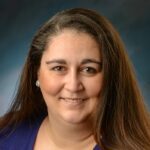 I enjoy sharing stories and want to share part of my personal story and how it connects with the topic of focus for this newsletter, “Professional Impact.” I will highlight the people—who did not know at the time—who guided my journey from a generalist technologist to a medical director.
This journey started at a national ASCLS meeting in 2009. I was a delegate for Iowa and our president, Jan Frerichs, tasked me to go to a few different committee meetings and bring back information to the state and share what I learned. One of my assignments was the DCLS Ad Hoc Committee. I walked into the room where the committee was sitting at a long wood table, and there were so many important people at the table.
Note, I say important people because, as a young person in our profession, I saw these leaders of ASCLS as so very important, and I was intimidated to speak with them because what did I know as a new technologist? They included Elissa Passiment, Dr. Susan LeClaire, Dr. Jim Griffith, Dr. Elaine Koehane, Dr. Nadine Fydryszewski, and others I recognized but did not know. I took a chair along the wall and got out my notebook. I listened to them discuss this advanced degree for the clinical laboratory scientist. The next steps that they needed to take were to explore certification criteria for this degree and to work on their strategic plan for the next few years.
“Professional impact is not just what we do as a profession to help the public, but what we do to impact one another.”
I did not really understand what they were talking about, this idea of a doctorate in clinical laboratory science. What would this person do? I went back to Iowa and told them what I had learned. Jan did not know that sending me to this meeting would impact my future educational goals. The people sitting at the table had no idea the person in the corner of the room would eventually join them at the table on the committee and serve as their board liaison. But their actions and words that day played a role in decisions I later made in my life.
The next year I participated in the ASCLS Leadership Academy run by Lynn Ingram with many ASCLS leaders and educators providing curriculum. This program taught me about my learning style, my communication style, and built a foundation for me to learn how to communicate with others—especially those who have differing communication styles. I gained courage to speak with others who I previously had found to be intimidating. That year at the ASCLS Annual Meeting I worked up the courage to walk up to Dr. Elaine Keohane and ask her, “What is this PhD you all keep discussing and what does this person do?”
She started with, well, it is not a PhD, but a clinical doctorate. I was thinking, well, I have no idea what the difference is. But she went on to explain and describe what a practitioner would do. It sounded like a very cool thing, but she said that it was still being developed. However, she did also explain to me about the masters in CLS program at the University of Medicine and Dentistry of New Jersey (UMDNJ), which is now a part of Rutgers. So, I set up a meeting with her to discuss that as an option to continue my education. I thought it would be very good to continue learning; it would help me to be a better technologist. I applied and was accepted into the program.
While taking one class at a time, I was learning so much more about clinical chemistry, coagulation, and transfusion medicine; it built on what I had learned in my undergraduate program and what I was doing and seeing every day at work. This education helped me better understood the work I was performing and how that related to the patient and their health. Having that conversation with Dr. Koehane motivated me to go back to school, which I had not otherwise thought was an option within our field, outside of moving towards public health or education.
Now, as I worked on my masters, I had a few supervisors who were very supportive and gave me stretch assignments that allowed me to use what I was learning to help me understand concepts and advance our laboratory. These supervisors, including Becky Gorsch and Kathy Ryerson, gave me confidence to grow my skills and gain practical experience. I was able to prove myself as qualified and become the supervisor of hematology and transfusion service at the VA.
I had a great team of supervisors to work with and learn from and was fortunate to have a facility that offers leadership programs and learning opportunities. Throughout the master’s program I worked with my advisor Dr. Koehane, and close to the end of my masters, my husband (who has been my greatest supporter of all) and I started a family. After graduation we welcomed our twin boys, and I took a year off from school.
When the boys were one, I reached out to Dr. Koehane and worked with her to apply to the new Rutgers Doctorate in Clinical Laboratory Science Program. After acceptance I began working with Dr. Fydryszewski and Dr. Elizabeth Leibach who guided me through the program. While going through the program, the pathologists I worked with, Drs. Icardi, Klutts, and Haugen, provided me the support to my residency and rounds with the healthcare teams. There were a few attendings and fellows who welcomed me to the rounding teams with open arms. These medical doctors helped me gain confidence in rounding, learn how to give a brief report at the patient bedside, and give consultations when laboratory medicine was important in treatment and diagnosis. Having people who support your endeavor, and not question the reason you are with the team rounding, can make so much difference in how you interact and learn.
A sudden change occurred at work, and I became our laboratory manager. Then I graduated during the COVID-19 pandemic. Those years were very busy, and I learned so much and used my training to aid in writing policy, aid in diagnosis of patients, and provide consultation to providers.
Throughout the entire journey, people continued to ask what my plan was after I graduated. Do you want to leave the VA and become a laboratory director in the private sector? Will you change what you are doing? I did not know. My goal from the very beginning of this journey was to learn more and help pave a path for others who wanted to become a DCLS someday. I had no idea when and if the VA would allow a DCLS education into their standards.
Pathology and Laboratory Medicine Service for the Department of Veterans Affairs knew I was going through residency; people in the national office knew I graduated; and they knew I was using my education to aid in my work with other disciplines in our healthcare system. In the government, we have a career series (0644 Medical Technologist), but there was not a doctoral level included, because there was no such thing when the standards were created. At that time, staying within the VA may mean that I would not ever have promotional opportunity within the laboratory walls. The laboratory has been my home for the last 19 years, and I was not ready to leave. I continued to work hard and show how a DCLS can function within the VA and provide laboratory management, clinical consultation, and leadership to a high complexity laboratory.
With continued work from ASCLS, other professional organizations, educational institutions, and laboratory personnel lobbying CMS to understand the place for the DCLS within the laboratory and healthcare, CMS did grant DCLSs the ability to be medical directors. With this great step forward, along with a multi-year effort to update the 0644 series standards, changes were made to now include a doctoral level position. The VA also updated its regulations (VA Directive 1106), which recognizes that a DCLS could be utilized as a laboratory director.
With all these wonderful updates and changes recognizing the DCLS, that did not automatically mean that I would get a promotion. We have a laboratory director in my facility, one that I am happy to work with. So, what did these changes mean for me, a DCLS with experience in technical work, managerial skills, and clinical patient facing background? Well, sometimes, timing is key. The VA is organized in regions called VISNs. I live in VISN 23, where our VISN laboratory medical director was getting ready to retire. She called me and asked if I would be interested in interviewing for her position. I was absolutely shocked! Did I even qualify for this position? Did it have to be an MD? It had always been an MD. Would the laboratory directors amongst the labs want to work with me? Could I hold my own in meetings with medical center directors and other medical directors? I was a bit scared and excited.
Well, turns out I am qualified. I have the appropriate education, a background where I have had the right mix of training and experience. After I interviewed and they reached out to offer the position, I was overjoyed that they picked me! This was a time when people had seen what I was doing as a DCLS and did not discredit me based on the title of my degree; they saw the opportunity they had in bringing in a different perspective and background to the team.
This new position made me the very first Doctor of Clinical Laboratory Science to ever be hired by the VA as a medical director. My title is Medical Director, VISN 23 Diagnostics Integrated Care Community for Pathology and Laboratory Medicine. I am now more than six months into the position and love the interactions with different leaders and the opportunity it gives me to provide laboratory medicine insight.
I would never be able to have this job, that I love, with a great team, if I had not had people who made an impact on me all along the way. Professional impact is not just what we do as a profession to help the public, but what we do to impact one another. I named some of the many positive and driven people who have mentored, given encouragement, pushed our profession forward, and provided education to me along the journey. If these people had not provided guidance and forged paths forward so I could get to where I am, then I would not be able to work to create paths for others. These people, along with so many others I cannot even begin to name, many of whom are within ASCLS, have made such a lasting IMPACT on me both professionally and personally. Thank you all; I hope I can make an impact on others as you have made an impact on me.
Lindsey Davenport-Landry is the VISN23 Diagnostics ICC (PLMS) Medical Director, VHA National EHRM Laboratory Services Co-Chair and Chief Medical Technologist at the Iowa City VAHCS, in Iowa City, Iowa.