
Volume 40 Number 4 | August 2026
Summary
Written in the witty voice of Lady Whistledown, this letter discusses the evolving role of laboratory professionals who, traditionally unseen, are increasingly engaging in advocacy to influence healthcare decisions. Lady Whistledown explores the various advocacy roles laboratorians can take on to ensure their voice shapes healthcare policy and practice, including a self-assessment to discover their personal advocacy archetype.
Dispatches from the Unseen Wing in the stylings of Bridgerton’s Lady Whistledown
Julie Freidhoff, MS, MLS(ASCP), Volunteer Contributor
 Dearest Gentle Reader,
It has come to this author’s attention that a rather curious development is unfolding within the realm: the laboratory—long presumed content to remain in the unseen wing—has at last, begun to attract notice.
One is relieved to report that, having been observed, its inhabitants have developed rather strong opinions about the decisions being made in their absence.
A most peculiar misconception nevertheless persists throughout the kingdom. Society appears to believe that the laboratory professional is content to remain hidden among humming analyzers and whirling centrifuges, quietly tending to specimens, somewhere beyond public view.
Curiously, this author observes that society is both correct—and entirely mistaken.
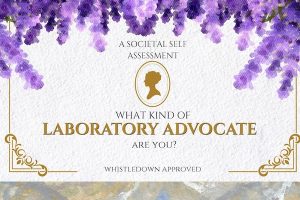
Take the quiz
For while laboratory professionals do indeed reside behind the scenes, their influence extends into nearly every patient encounter. Lives are guided, decisions are shaped, and outcomes are informed by individuals who may never meet the patients they serve nor the providers who depend upon their expertise. One might even say they are healthcare’s most devoted wallflowers—present at every ball, yet seldom introduced. How delightfully mistaken society can be.
For while the laboratory has long occupied the unseen wing of healthcare’s grand estate, an increasing number of its inhabitants have begun to venture toward the edges of the ballroom. One cannot help but observe laboratory professionals appearing in legislative chambers, educational forums, community gatherings, and policy discussions with growing frequency. Some might even call it a most curious advocacy season.
And what, dear reader, is advocacy if not the art of ensuring one’s voice is heard before others presume to speak on one’s behalf?
“And what, dear reader, is advocacy if not the art of ensuring one’s voice is heard before others presume to speak on one’s behalf?”
The stakes, as one might imagine, are rather more consequential than securing a favorable dance partner. Matters of professional standards, workforce sustainability, patient safety, equitable access to care, and the future of laboratory medicine itself are very much at play. Yet many decisions affecting the profession are made by individuals who have never witnessed a critical value called in the middle of the night, investigated a perplexing discrepancy, or appreciated the precision required to transform a specimen into life-altering information.
One can hardly fault them entirely. It is difficult to appreciate what one cannot see.
Thus, laboratory professionals find themselves in a rather unusual position: serving simultaneously as experts and ambassadors. This author observes that they must translate their work for policymakers, administrators, educators, and communities who may never realize how frequently laboratory data shapes every clinical decision.
Indeed, one cannot help but notice a curious transformation taking place throughout the kingdom. Having spent years mastering their craft, many laboratory professionals are now stepping fully into their advocacy season.
Like the finest debutantes, they arrive not by accident, but through years of preparation. They have studied, practiced, refined judgment, weathered unexpected challenges, and developed confidence earned only through experience. The difference, of course, is that instead of curtsies and quadrilles, they bring data, expertise, and unwavering commitment to patient care.
Some step boldly onto the ballroom floor. Others prefer the relative safety of the drawing room or unseen wing, venturing outward only with encouragement from a trusted mentor, professional society, or a particularly wise Lady Danbury of the profession. Yet the kingdom benefits each time another laboratory professional finds their voice and joins the conversation.
And yet, not all influence requires stepping onto the ballroom floor at all.
Some of the most meaningful contributions occur in quieter spaces within the unseen wing: mentoring a colleague, encouraging a hesitant professional, or recognizing strengths in others before they recognize them themselves. Advocacy, in its fullest expression, is not only about speaking—it is also about cultivating those who will.
Society is forever preoccupied with identifying its diamonds and sparklers—the brilliant individuals whose talents command immediate attention. Yet this author has observed that every successful season owes an equal debt to its Lady Danburys: those wise souls who make introductions, cultivate connections, offer timely encouragement, and gently nudge others toward their strengths. Advocacy, dear reader, is not reserved solely for those standing in the spotlight. Quite often, it is the person arranging the dance card who shapes the evening’s most important outcomes.
The laboratory possesses something of tremendous value: expertise. Yet expertise concealed serves little purpose. Knowledge achieves its greatest good when it is shared, translated, and applied in service of others.
The laboratory has never lacked expertise. What it has occasionally lacked are sufficient introductions between that expertise and the conversations shaping healthcare’s future.
Fortunately, every season produces its share of advocates. Some step confidently into the ballroom. Others remain in the drawing room or unseen wing, where they quietly mentor, encourage, and cultivate the next generation. Both serve the profession admirably.
After all, every diamond who dazzles society is often supported by a Lady Danbury who recognized their potential long before anyone else did.
This author suspects that laboratory professionals suffer from a most curious assumption: that expertise alone will secure an invitation to the ball. Alas, society has never functioned in such a manner. Advocacy is not the replacement of expertise—it is the sharing of it.
For generations, the laboratory has observed from the edges of the ballroom while others determined the evening’s agenda. Yet one cannot expect laboratory expertise to influence conversation if no one carries it into the room. Fortunately, advocacy is rarely a solitary endeavor. Some step forward publicly; others ensure they are prepared, supported, and encouraged to do so.
The question, dearest Gentle Reader, is whether laboratory professionals will have a seat at the table when they do.
And perhaps a more curious question now emerges: What manner of advocate might one be within this unfolding season?
Rather than leave such matters to speculation, this author has taken the liberty of preparing a brief society assessment. One might consider it an exercise in self-discovery … or, more properly, a classification of advocacy archetypes.
Dearest Gentle Reader, you are formally invited to discover your place within the season. Take the quiz to reveal your laboratory advocacy archetype—and do share your result, should you feel inclined to let the ton observe your findings. For in advocacy, as in society, one rarely walks alone … and one is never quite as anonymous as one believes.
And so, to those who have stepped forward as Labvocates—to those who write, teach, mentor, educate, testify, volunteer, champion the profession, or quietly encourage others to do so—this author offers her admiration. Whether you enter the ballroom as a diamond, a sparkler, or a trusted Lady Danbury, your efforts ensure that the unseen wing remains unseen only in location, never in influence.
For when laboratory professionals advocate for their profession, they are ultimately advocating for the patients. The two, despite appearances, have never truly been separate.
After all, dear reader, the most consequential voices are not always the loudest. Sometimes, they are simply the most informed or self-aware.
One can only hope each professional embraces their strengths and allows those strengths to guide the many forms that advocacy may take.
With keen observation and continued admiration,
Lady Whistle DNAwn
(pronounced Whistledown)
Julie Freidhoff is a Coach and Consultant at SafeSpace Coaching and Consulting in Rochester, Minnesota.