
Volume 39 Number 5 | October 2025
Summary
A student-led project at McNeese State University used expired blood bank reagents to study their accuracy in blood typing, blending research with education. Results showed expired reagents were moderately reliable for ABO typing but unreliable for Rh typing. Beyond findings, students gained confidence, technical skills, and research experience, reinforcing the value of hands-on learning in medical laboratory science.
Using Research to Strengthen Blood Bank Education
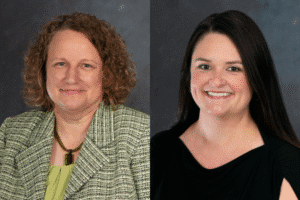
Sonya Hidalgo, EdD, MLS(ASCP), ASCLS Today Volunteer Contributor
Whitnee Brame, MS, MLS(ASCP), ASCLS Today Volunteer Contributor
 In a blood bank, expired reagents are typically discarded, but could they still have clinical value? That question sparked a student-led research project at McNeese State University, where medical laboratory science (MLS) faculty paired hands-on learning with real-world data collection. We are always looking for innovative ways to strengthen student learning, especially in areas where hands-on application is critical. In 2024, we launched a unique student research project that used expired blood bank reagents to explore a very real-world question: “Can these reagents still yield accurate results for blood typing?”
With support from a $7,000 Shearman Research Initiative Fund grant, we acquired fresh reagents and equipment and designed a student-led comparative study. Five MLS students enrolled in an elective MLS research course and conducted the research project over one semester. Each student performed a series of blood typing assays using both expired and in date reagents, comparing their performance and tracking discrepancies.
Bridging Education and Research
This project wasn’t just about lab technique, it was about giving students a meaningful way to apply immunohematology concepts, interpret data, and engage with the scientific process.
Along the way, students:
- Gained confidence in blood bank techniques, performing assays earlier in their curriculum than typical.
- Practiced objective data collection using standardized laboratory forms.
- Conducted basic statistical analyses, interpreting their results and learning about sources of variability.
- Reflected on quality assurance principles, especially the real-world implications of expired reagents in lab settings.
Perhaps most importantly, they experienced the power of research to answer questions that matter, not only to laboratory professionals, but to patient care.
Research Design and Statistical Findings
The student research team tested 63 donated, whole-blood specimens, performing ABO and Rh blood typing using both expired and newly acquired in-date reagents. Students recorded each result and evaluated for discrepancies by comparing outcomes with known confirmed blood types. Discrepant results were classified as either ABO-related or Rh-related errors.
The final results showed that 30 of the 63 tests (47.6 percent) were consistent with the known blood types and showed no discrepancy. The remaining 33 results (52.4 percent) demonstrated discrepancies. Among these, five were classified as ABO errors (7.9 percent of all tests), and 28 were classified as Rh errors (44.4 percent).
A chi-square test of independence was performed to determine whether ABO and Rh errors occurred independently, rather than one influencing the other. The resulting p-value was .106, indicating no significant statistical relationship between the two error types; this implies that they occurred independently. This led students to conclude that while expired reagents may still be acceptable for demonstrating ABO blood typing in educational settings, their reliability for Rh typing is considerably less robust and potentially misleading. Students researched Rh antigens and concluded that the higher error rate with Rh typing was likely due to the weaker antigen expression of Rh factors.
It’s worth noting that the testing was conducted by early-career MLS students who had not yet entered the blood bank simulation course. While this provided valuable early exposure, it also introduced the possibility that some discrepancies resulted from student technique rather than reagent degradation.
Faculty Observations and Student Growth
In addition to the technical findings, we observed significant growth in the participating students. Students developed better pipetting and sample handling techniques, strengthened their confidence with test interpretation, and began to understand the nuance of reagent sensitivity and specificity. The opportunity to troubleshoot errors and interpret real-world data introduced them to an often overlooked but vital part of laboratory medicine: quality assurance. Our project team presented their findings at our university’s Undergraduate Research Symposium—a first for our MLS Program.
This project also taught time management and teamwork. Students coordinated schedules, practiced good lab practices, and worked under faculty supervision while still directing their own inquiry. As a result, they became more invested in the integrity of their results and more appreciative of the scientific process.
Building a Culture of Research in MLS
This project marks an important step in expanding undergraduate research opportunities within our MLS program. By integrating a real-world problem into the curriculum and providing the structure and support to investigate it, we encouraged students to become not just future lab professionals, but contributors to the profession’s body of knowledge.
Following this pilot, our program aims to extend this type of experience to more students. We hope to investigate additional reagent types, such as antibody screening cells and perhaps design simulated emergency protocols for reagent shortages. Each step forward helps create a culture where MLS students see themselves as active participants in clinical science.
We believe this initiative can serve as a model for other MLS programs seeking to incorporate low-cost, high-impact research that empowers students and reinforces core professional values.
Student Reflections
We enjoyed seeing these MLS students learning about and participating in immunohematology at a much earlier point than usual. One student noted, “I found the experience both fascinating and incredibly relevant to my line of work. I’m in my sixth year working as a non-clinical instructor at a local blood center but am now working to advance my career and become a medical laboratory scientist. This early exposure has not only given me a head start on future coursework, but it’s also given me a clear sense of what my future in the field could look like—and confirmed that I’m pursuing the right path.”
Final Thoughts
Hands-on research doesn’t have to be complex to be transformative. By giving students the tools, guidance, and space to explore real questions in clinical lab science, we’re not just preparing them for clinical rotations, we’re preparing them to lead.
A special thanks to the students at the McNeese State University, Medical Laboratory Science Program who conducted the hands-on research, performed the statistical analyses (with our help), and presented their findings at our institution’s Research Symposium: Emma Guidry, Toni Loescher, Jessica Lytle, Emily Nguyen, and Kadie Reon.
Sonya Hidalgo is MLS Program Director and Assistant Professor at McNeese State University, Medical Laboratory Science Program in Lake Charles, Louisiana.
Whitnee Brame is MLS Assistant Professor and Safety Officer at McNeese State University, Medical Laboratory Science Program in Lake Charles, Louisiana.
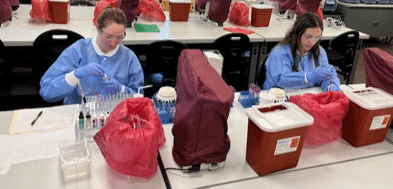
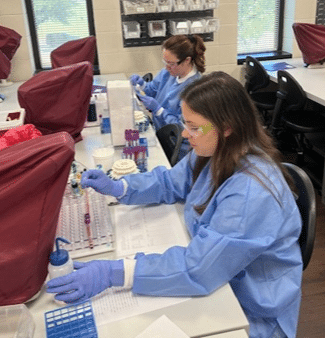
McNeese State University medical laboratory science students conducted a student research project that used expired blood bank reagents to explore a very real-world question: “Can these reagents still yield accurate results for blood typing?”