
Volume 40 Number 1 | February 2026
Summary
This article emphasizes that every medical laboratory test represents a real patient whose safety depends on accuracy. It highlights how errors can jeopardize care and stresses accountability, mindfulness, and leadership in fostering a culture where precision and ethical responsibility outweigh speed in the laboratory.
Reinforcing a Culture of Accuracy and Accountability in the Laboratory
Donald Kris Anunciado, MLS(ASCP), ASCLS Today Volunteer Contributor
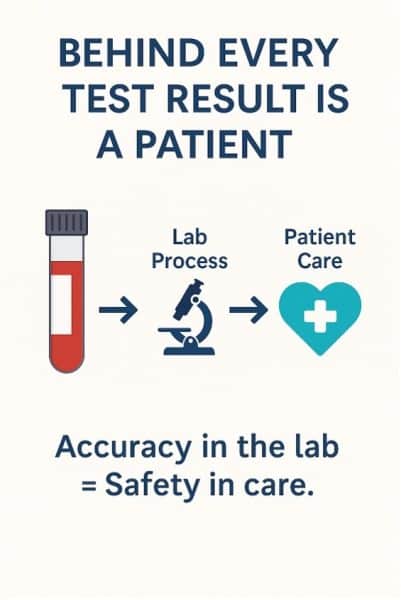
 Working in the laboratory, we see a lot of tubes we accept and run tests in our laboratory, each with their own numbers, labels, and barcode. However, it is important to bear in mind that every barcode is a person waiting for answers, comfort, or hope. The point is, behind every test result is a patient, and that is what our profession is all about.
Accuracy is Patient Safety
The theme of the 2024 World Patient Safety Day by Revival Research Institute focused on the slogan “Get it right, make it safe!” It is true that the laboratory is one of the most critical checkpoints in the continuum of care. A mislabeled specimen, or a skipped quality control (QC) verification can cascade into a wrong diagnosis, delayed transfusion, or inappropriate treatment. Accuracy in the lab equals safety in care. It is not a slogan; it’s the core of our ethical obligation as medical laboratory professionals.
 Challenges that Threaten Accuracy
It is important to bear in mind that as human beings, we are subject to committing human errors. No one is perfect. That’s why maintaining accuracy isn’t always easy and is more challenging than just by saying it. Situations wherein accuracy gets compromised usually happen during staffing shortages, high specimen volumes, and expanding test menus, leading to the stress of medical laboratory professionals. Multitasking, although a great quality to have, can lead to errors and sample mix ups. Fatigue from working every day or working a 12- or 16-hour shift can blur the focus. Automation, which is implemented more commonly in the lab right now, can also create false results if not manually verified by the medical laboratory professional.
Human factors like distraction, burnout, and complacency often pose greater risks than any technical malfunction. We might run a lot of samples and tests in a shift, however, one simple mistake in the lab can affect the entire care plan of a patient. That is why the challenge is not just of technical competence but also of mindfulness.
Cultivating a Culture of Accuracy and Accountability
Even though we are working in a fast-paced work environment, when we value safety over speed, we tend to become more accurate, which leads to fewer errors and less concern regarding patient safety. Simple but powerful habits reinforce this is by:
- Peer verification: Even though you are confident with your work, having somebody double check it tends to lessen and correct small errors.
- Mindful pauses: In connection with the first habit, another thing to do is to take 10 seconds to breath before releasing a result, which can reset attention.
- Transparent communication: Because we are a team working in the lab, communication is very important, and management should encourage the laboratory professionals to speak about mistakes without fear of punishment.
Leaders play a key role. When supervisors reward accuracy and ethical awareness as much as turnaround time, the message is clear: patient safety comes first. New professionals quickly learn that quality is not negotiable, and seasoned staff feel empowered to uphold standards even under stress.
Conclusion: Accuracy in the Lab = Safety in Care
The next time we scan a barcode, run a test, perform QC, verify a result, take a moment to realize that we are handling patient lives in our hands right now. It is important for us to be very careful with our work. As laboratory professionals, we should always seek accuracy and perfection. Maybe it’s a gel crossmatch, a bilirubin test for a newborn, a CBC, or any other test, be sure to always double check and practice accuracy.
Every test result is more than data—it’s a bridge between science and healing.
Behind every test result is a patient.
Accuracy in the lab equals safety in care.
Donald Kris Anunciado is a Medical Laboratory Scientist I at Vitalant in Chicago and an MBA-Healthcare Administration candidate at Western Governors University. He also serves as Clinic Operations Manager at Optimal Wellness & Beauty.