
Every year, the Clinical Laboratory Educators Conference (CLEC) brings together a vibrant community of educators who share ideas, swap practical tools, and leave inspired to elevate their programs. The stories below—from program directors who once felt overwhelmed, to seasoned educators who still discover something new each year—show just how transformative CLEC can be. Whether it’s innovative teaching tools, fresh strategies to engage students, or the invaluable support of colleagues who truly understand the challenges of laboratory education, CLEC offers something that resonates long after the conference ends.
CLEC 2026 will be held February 5-7 at the Hyatt Regency Bellevue in Bellevue, Washington, near Seattle. Attend in-person or virtually. Regular registration ends January 21! Save your spot!
James C. Williams Jr., PhD, MLS(AMT), MLT(ASCP), MLT and Phlebotomy Program Director at St. Philip’s College, San Antonio, TX
Jennifer Lichamer, MPH, CHES, MLS(ASCP), Director of Clinical Lab Technology AAS Program, Histotechnology AAS Program, and Histotechnology VS Certificate Program, Elgin Community College, Elgin, IL
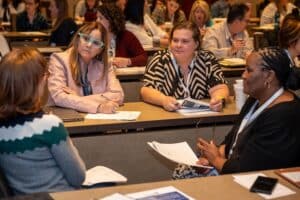
Attendees at the 2025 Clinical Laboratory Educators Conference share experiences and best practices.
For the first two years I attended CLEC, I felt completely overwhelmed and wasn’t sure where to start because everything was so new. I’d like to shout-out to Stephanie Cochrane and April Orange for sitting down with me and walking me through the expectations for a program director, how to find and use the resources in place to assist new directors and educators, and for sharing their wisdom and support.
The people I have met through the CLEC convention are all there to help strengthen their programs, incorporate best practices for their students, and support each other and the profession. I found that the third CLEC meeting was the charm for me; I felt like I was better able to prioritize which sessions best suited the gaps I was experiencing and settle in. One session I attend discussed how to use choice boards as an opportunity to engage students with the course content in different ways. I adopted this activity this fall and the feedback I am getting from the students is that they appreciate the nudge to really dig into the material with fresh eyes, in a way that works best for them. They even got a little competitive about their projects (in a very friendly way).
Candice Grayson, MS, MA, MLS(ASCP)CM, Program Director, MLT & HT, Community College of Baltimore County, Baltimore, MD
CLEC 2026 Steering Committee Chair
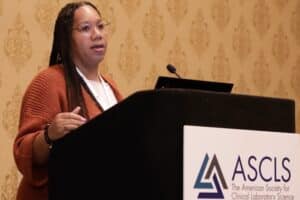
Stephanie Cochrane presents at the 2024 Clinical Laboratory Educators Conference.
I am so excited to attend and encourage you to, as well. Last year, I used a tool that Stephanie Cochrane had mentioned in one of her sessions the year prior, “Cellfies,” while I attended CLEC my students were gathering selfies and relating them to hematology cells. The students loved playing and learning, and I loved that the learning was continuing for both (student and teacher).